

An aircon cleaning company writes aircon cleaning on its home page, because that is what the job is called. In the Philippines that phrase is typed about 390 times a month. Aircon cleaning services, which is the phrase customers actually use, is typed about 9,900 times. The service is identical. One word separates the two phrases, and one of them is typed twenty five times more often.
Keyword research is the work of finding that difference before you write the page rather than a year afterwards. It has a reputation for needing software that costs more each month than a small business spends on its entire website. It does not. Everything below uses tools Google gives away, and the two figures above came out of one of them. You can reproduce both in about ten minutes.
In short
- Start with the words your customers already say to you. A tool only expands the list you hand it, so the first list has to come from you.
- Search Console is the best free keyword tool you own, and it reports what Google actually did rather than what a tool estimates.
- Keyword Planner is free without running advertisements, but set the location to the Philippines or you will be reading somebody else’s country.
- The biggest number is usually the wrong one. Look at the results page before you commit a page to a phrase.
Before you start
You do not need software and you do not need to be technical. You do need four things:
- A Google account you own, not one belonging to a former web designer.
- Google Search Console connected to your site and left running for at least a few weeks. If that is not done yet, do it first: it is step two of our guide to the first seven steps of SEO.
- A spreadsheet, or a sheet of paper if the business is small enough.
- About two hours, best spent as one hour now and one hour a week later, once you have stopped thinking about it.
If you have no website yet, the work still pays. The list you build here is what the pages get written from.
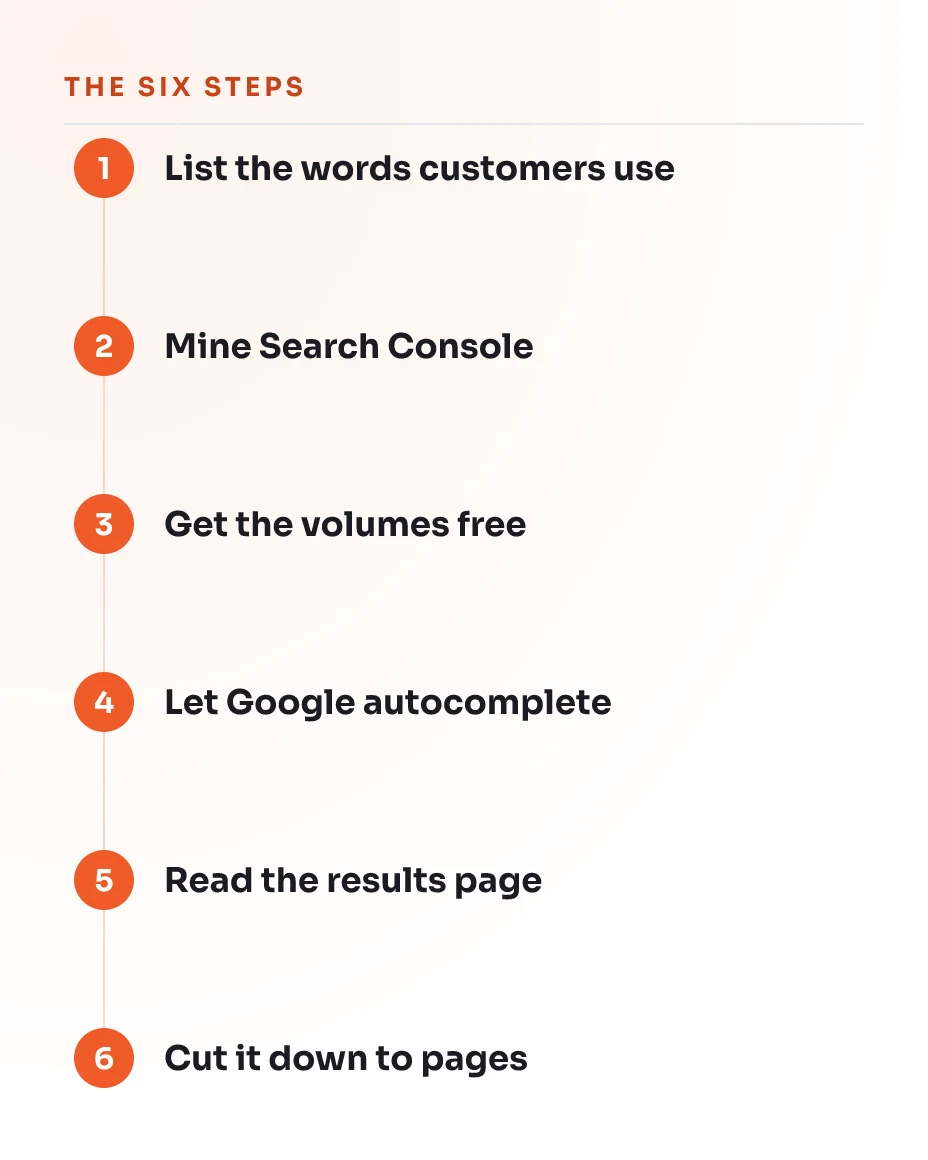
Step 1: Write the list before you open any tool
When this is done you have twenty or thirty phrases that came from real customers, which is the one list no tool can generate for you.
Every keyword tool works the same way. You give it a phrase and it gives you related phrases. That means the quality of everything downstream is decided by what you type first, and business owners almost always type the words the industry uses rather than the words the customer uses.
- Open the last thirty enquiries you received, wherever they arrived. Write down the words the customer used, not the words you would have used.
- Add the vocabulary you use inside the business that a customer never says out loud, and mark it. Industry language on a website is one of the most common reasons a good page gets no visitors.
- Add every city, municipality and barangay you genuinely serve, and leave out the ones you would like to serve but do not.
- Add the brand names that come up. People search for the make and model of the thing they own far more often than businesses expect.
Check it worked if the list contains at least three phrases that make you slightly uncomfortable, because they are not how you would describe your own business. Those are usually the valuable ones.
Step 2: Take the words Google already knows you for
Afterwards you have a second list made of searches that already brought somebody to your site, including several you would never have guessed.
This is the step people skip, and it is the only free source of data about your business specifically rather than about your industry. Search Console reports what Google actually did, not what a tool estimates it might do.
- Open the Performance report, set the date range to the last three months and open the Queries tab.
- Sort by impressions rather than by clicks. Impressions are the searches where Google showed you and nobody tapped, which is where the opportunity sits.
- Pay attention to queries sitting between position eight and position twenty. Those are pages that nearly rank, and moving one of them is far less work than starting a new page.
- Copy out anything phrased as a question. People type questions and businesses write statements, which is usually why the questions are unanswered on your own site.
Check it worked when you find at least three queries you did not expect to see. If the report is empty, Search Console is either not verified or not old enough. It holds no record of anything before the day it was set up.
Step 3: Get the numbers from Keyword Planner without paying for advertising
This is where the list stops being opinion. Keyword Planner puts a monthly figure beside every phrase, free, and without a single advertisement running.
- Create a Google Ads account, which costs nothing. Google will steer you towards building a campaign during signup. Look for the option to skip that and go straight to the account.
- Open Tools, then Keyword Planner, then Discover new keywords.
- Check the location setting before you read a single number. If it says anything other than Philippines, every figure on the screen belongs to a country you do not sell in. Set the language to English while you are there.
- Paste your list from steps one and two, twenty phrases at a time, and export the results.
Those numbers come with limits the screen does not mention:
- With no spend on the account, the figures appear as ranges rather than exact counts. A range is enough for choosing between two phrases and not enough for a forecast.
- Keyword Planner groups close variants and reports the group. Two phrasings of the same thing can show an identical figure, and they are one opportunity rather than two.
- The figures are yearly averages, which hides anything seasonal. A service people only think about after a typhoon or before Christmas looks smaller on the screen than it feels in the business.
Check it worked when at least one phrase you were about to build a page on turns out to be much smaller than a phrase you had not considered. That is the whole point of the exercise, and it happens most of the time.
The account you just made is explained in our entry on Google Ads, and you are under no obligation to ever run anything in it.
Step 4: Let Google finish your sentences
This gives you the question shaped phrasing that a volume tool will never show you, because individually those searches are too rare to report and together they are larger than the headline phrase.
- Type your main phrase into Google and do not press enter. Write down the ten suggestions that appear underneath.
- Type the phrase again and add a single letter after it, then work through the alphabet. Each letter produces a different set.
- Press enter, then open every question in the People Also Ask box. Opening one adds more underneath it, and you can keep going until they repeat.
- Scroll to the bottom of the results for the related searches, which are phrased differently again.
Do all of this in a private or incognito window. Signed in, Google shapes the suggestions around your own history, and your history is the history of somebody who runs the business rather than somebody who needs it.
Check it worked when you have ten questions written in a customer’s own words. Each one works as a heading, and several are worth a page of their own. The box itself is covered in our entry on People Also Ask.
Step 5: Look at the results page before you commit
Before a phrase goes on the final list, search it and look at what Google already shows. The results page is Google telling you what it believes that searcher wants, and if that is not what you sell then the phrase is unusable at any volume.
Aircon maintenance is typed about 90,500 times a month in the Philippines, and clean aircon coils about 33,100. Both look like a gift next to the 9,900 for aircon cleaning services. Search them and the first page is instructional articles and videos about doing the job yourself, because that is what those people came for. A service page will not rank there, and on the rare occasion one does, the visitors do not book anything. Aircon cleaning services returns companies, which is what makes the smaller number the better keyword.
- Search the phrase in a private window, on a phone, in the town you actually sell in.
- Ask one question about the first page: are these companies selling the thing, or articles explaining it? The answer tells you whether to write a service page, to write an article, or to leave the phrase alone.
- If the first page is entirely national directories and household names, the phrase is out of reach for now. The same phrase with your city on the end usually is not.
- Note whether a map of three local businesses appears. When it does, your listing decides more than your page does.
Check it worked when at least one large, tempting phrase has been crossed off the list. If nothing was crossed off, the reading was too generous.
What you are judging here is search intent, the habit of doing it is SERP analysis, and the box of three local results is the map pack.
Step 6: Cut the list down to pages you can actually write
What you should be holding at the end is a short list of pages rather than a list of words. Each page gets one phrase beside it and a reason that phrase can be won.
- Delete every phrase where step five showed the wrong intent, however good the number was.
- Delete every phrase describing something no version of your business will ever sell.
- Group what survives. Phrases that mean the same thing to a customer belong to one page, not to three.
- Sort by how close the searcher is to buying rather than by size. Aircon cleaning services in Mandaue is worth more to a cleaning company than aircon maintenance, at a fraction of the volume.
- Give the top five a page each, and write down in the spreadsheet which page owns which phrase.
That last line matters more than the research does. Two pages chasing one phrase is keyword cannibalisation, it is nearly always accidental, and it quietly undoes the work you have just done. The rule for assigning phrases to pages, and what to do when two pages already overlap, is step three of the first seven steps.
Common mistakes
- Reading the numbers for the wrong country. Keyword Planner will happily show you American search volumes for a business in Cagayan de Oro, and nothing on the screen warns you.
- Treating volume as the important column. It is the least important one. Intent decides whether the visitor can buy, and location decides whether you can reach them.
- Building the list from a competitor’s website. You will inherit their mistakes, including the ones that are the reason they are not ranking either.
- Ignoring everything the tool reports as zero. Zero frequently means too specific to measure, and too specific to measure is often the phrase typed by somebody with a wallet already open.
- Doing it once. The words move. New products, new brand names and new ways of asking arrive every year, and a list built two years ago is describing a market that has changed underneath it.
- Writing the phrase into the page over and over. Choosing the right word is the work. Repeating it fifteen times does nothing, and has done active harm for years.
What success looks like
A week after finishing, you should have all of this without having paid for anything:
- A spreadsheet of five to ten pages, each with one phrase against it and no phrase appearing twice.
- At least one phrase from Search Console that you would never have thought of, because a real person typed it.
- At least one large, obvious phrase crossed off after you looked at the results page and saw that it belonged to somebody else’s audience.
- The vocabulary on your website starting to match the vocabulary your customers use, which is the thing keyword research is genuinely for.
None of that requires a specialist. It requires two hours and the willingness to be told that the phrase you have used for years is not the phrase anybody types.
The honest limit
When to stop doing it yourself
Everything here works for a site of five to twenty pages selling a handful of things in a handful of towns, which describes most businesses that will ever read it. The point where it stops paying off is the point where the list gets long. A few hundred phrases cannot be sorted into pages by hand without something going wrong, judging whether you can beat the sites already ranking needs data the free tools do not publish, and once a list is long enough to need a site structure the decision has stopped being about words and become about architecture. If you are looking at a spreadsheet you can no longer hold in your head, that is the moment to ask someone, and not before.
Questions we get